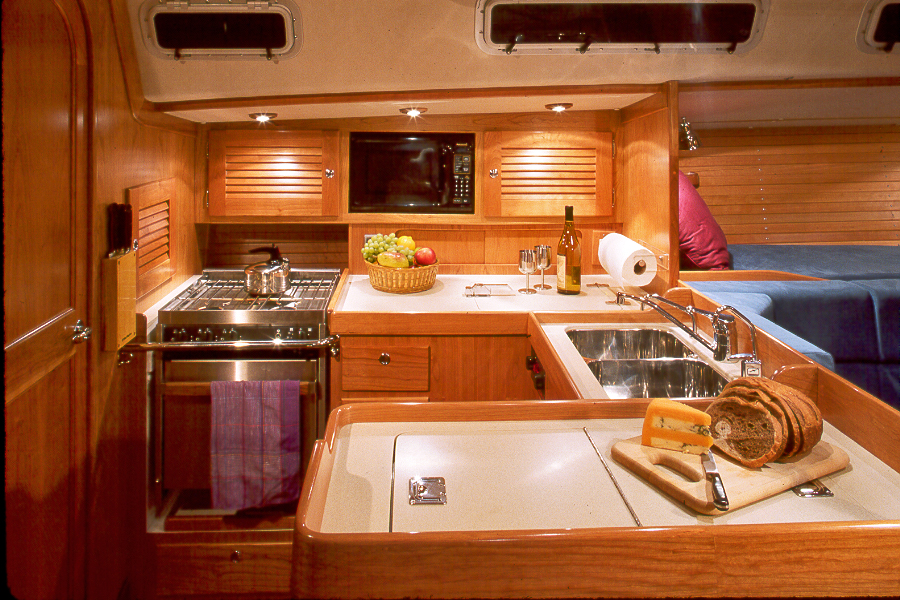
The galley is where you will spend more time than you expect, and where small design flaws become daily frustrations. If you are buying a boat, or choosing a charter yacht for a season, the galley deserves as much attention as the rig or the electronics. It will shape your daily experience far more than either.
Why the Galley Matters More Than You Think
On land, a bad kitchen is an inconvenience. On a boat, a bad galley quietly changes everything. It affects what you eat, how often you cook, how much water you use, and how the crew feels after a few days onboard. You are working within constraints that do not exist ashore. Cold storage is limited, fresh water is finite, and every task happens on a moving platform. The person cooking is rarely just a cook. They are also sailing, navigating, managing the crew, or dealing with tired children. When the galley does not work, you feel it immediately. Meals become repetitive, preparation becomes effortful, and the crew starts defaulting to snacks or eating ashore more often than planned. Over time, this changes the rhythm of the entire trip. A well-designed galley does the opposite. It reduces effort, supports simple routines, and allows you to feed people properly without thinking too much about it. That is what you are looking for.
What to Look for in a Sailboat Galley
Layout: The Difference Between Working and Struggling
The layout determines everything else. Most cruising boats fall into two categories: L-shaped galleys and inline, corridor-style galleys. Many modern yachts are designed with inline galleys because they are expected to spend most of their time in marinas, at anchor, or on short coastal passages. Charter use and liveaboard life prioritise open interiors, social space, and ease of movement over working efficiency under way. The galley becomes part of the living area rather than a secure working station. The L-shaped layout, by contrast, is built around function at sea. It allows the cook to brace against the corner, keeping balance without effort even when the boat is moving. The stove, sink, and working surface are all within reach, so you are not stepping back and forth while preparing a meal. This matters more than it might seem when the boat is heeled or bouncing slightly. Inline galleys work well in calm conditions but become less comfortable as soon as the boat starts moving. You are standing in a passageway with limited lateral support, relying more on your legs to stay balanced. Over the course of a trip, that becomes tiring, especially when cooking more than once a day. A simple way to evaluate any galley is to stand at the stove and reach for the sink. If you can do that without moving your feet, the layout will work in most conditions. If you cannot, cooking becomes constant movement rather than a contained task.
The Stove: Reliability and Control Underway
Most cruising boats in Europe still use gas stoves, and there is a reason for that. Gas is immediate, predictable, and independent of the boat’s electrical system. It allows you to cook properly without worrying about battery levels or inverter limits. Electric induction systems are appearing more often, particularly on newer boats, but they require a level of electrical infrastructure that many cruising setups do not have. Without large battery banks, solar capacity, or a generator, they quickly become restrictive. Running multiple burners or combining cooking with other electrical loads is often not realistic. The feature that matters is whether the stove is gimballed. A gimballed stove swings to remain level as the boat heels, which keeps pots stable and cooking manageable. Without it, even moderate movement can make cooking impractical. This is one of those details that seems minor in a marina and becomes decisive at sea. Older boats sometimes still carry alcohol stoves. They tend to be slow and inefficient, and most crews replace them as soon as they begin using the boat seriously.
Fridge and Cold Storage: The Real Constraint
The fridge is the single most important piece of equipment for provisioning, and it is often underestimated. A small icebox may appear sufficient during a quick viewing, but over the course of a week it becomes a limitation that defines what you can and cannot cook. On most 40 to 45 foot cruising boats, a crew of four will need roughly 80 to 100 litres of usable fridge space to provision comfortably for several days. Anything less forces frequent resupply or a shift toward dry and long-life food. Top-loading fridges tend to perform better because cold air remains inside when opened. Front-opening units are more convenient but lose cold air quickly, which increases energy consumption. On a boat where power is limited, that difference matters. Power draw is equally important. A fridge that runs continuously and pulls several amps can deplete a modest battery bank within a day if the system is not properly sized. When evaluating a boat, the fridge should never be considered in isolation. It needs to be understood together with battery capacity, charging sources, and expected usage patterns. This is also where many crews run into trouble with provisioning. The amount of food you bring onboard has to match the storage reality of the boat. If it does not, you either waste food or change how you eat. In practice, this is harder than it sounds. Most people think in terms of meals, not volume. A few extra fresh items, bulkier ingredients, or poorly chosen packaging can quickly fill the available space without it being obvious at the time of purchase. This is exactly the constraint modern provisioning tools need to handle. In Victuo, storage is not treated abstractly. Each product is associated with an estimated physical volume and storage requirement, allowing the system to approximate how much space your plan will actually occupy. Dense items such as canned goods behave very differently from bulky fresh produce or pre-packaged meals, even if their calorie contribution is similar. By accounting for product-level density and volume, the plan can be adjusted before you shop. Meals that rely heavily on high-volume ingredients can be balanced with more space-efficient alternatives, and cold storage limits can be respected without manual estimation. The result is a plan that fits the boat, not just on paper, but in the fridge and lockers as they exist in reality.
Water at the Galley: Where It Actually Goes
Fresh water capacity on most cruising boats sounds generous on paper, often somewhere between 200 and 400 litres. In practice, it disappears quickly, and the galley is where most of it is used. A saltwater foot pump next to the main tap is one of the most practical features a galley can have. It allows you to rinse dishes, vegetables, and cookware using seawater, and then finish with a minimal amount of fresh water. Over the course of a trip, this can significantly reduce consumption without affecting comfort. Hot water systems are also worth checking. Many boats heat water through the engine cooling loop, which means you have hot water available after motoring. It is a small detail, but one that makes daily routines noticeably easier, especially when cleaning up after cooking.
Storage: The Daily Reality
Storage is just as important, particularly access. Deep lockers are useful for bulk provisions, but everyday items need to be within reach. If you have to dig through compartments behind seating or under tables every time you cook, the process becomes unnecessarily difficult. Well-designed galleys tend to have small details that make a large difference over time. Fiddle rails keep items from sliding, nearby lockers hold frequently used ingredients, and the overall layout reduces unnecessary movement. These are not headline features, but they define how the space feels after several days onboard.
Ventilation and Lighting: Comfort and Safety
Ventilation becomes critical as soon as you start cooking in warm conditions. Without an opening hatch or nearby portlight, heat and humidity build quickly, especially in Mediterranean climates. A galley that cannot be ventilated properly becomes uncomfortable to use, which discourages cooking altogether. Lighting plays a similar role. A single overhead light creates shadows exactly where you are working. Proper task lighting over the stove and counter improves both safety and comfort, particularly in the evening. Good lighting does not need to be complex, but it needs to be positioned correctly.
A Simple Way to Decide
When you step aboard a boat you are considering, spend time in the galley. Stand at the stove, reach for the sink, open the fridge, and imagine preparing a full meal after a long day on the water. Picture the boat slightly heeled, the crew waiting, and the space fully in use. If the movements feel natural and contained, the galley will support you. If they feel awkward or forced, that friction will repeat itself every day of your trip. A galley is not just a kitchen. It is a working space that sits at the center of daily life onboard. When it works well, everything else becomes easier. When it does not, you feel it immediately, and you keep feeling it. If the galley works, the boat works.