Not just a planner — a provisioning engine.
Victuo combines nutrition logic, sailing conditions, storage constraints, and crew behavior to generate plans that actually work in real life.
Victuo solves provisioning in 3 layers.
What to eat
A meal plan shaped by your trip — not a recipe book.
What to buy
A shopping list with exact quantities, grouped for the supermarket.
How it fits your trip
Crew needs, storage limits, and sailing conditions — all accounted for.
What the engine actually does.
Every plan is shaped by 6 interconnected systems. They run together — not as separate features bolted on.
Sailing-aware day archetypes
Each day is classified: embarkation, heavy sailing, marina day, offshore watch, party night, settled cruising. The archetype drives calorie targets, cooking effort limits, no-cook bias, and snack allocation. A heavy sailing day gets no-cook, high-energy meals. A marina day gets lighter food with an eating-out option.
Climate and weather signals
Temperature band for the region and month generates heat stress, comfort food bias, freshness preference, and hydration scores. A hot Mediterranean July shifts meals toward salads, cold dishes, and fruit — and increases water allocation by up to 50%.
Equipment-matched selection
No oven? Meals requiring an oven are excluded before scoring. Only cooktop? One-pot meals rank higher. The galley constraints are hard filters — not soft preferences. You won’t get a meal you can’t cook.
Storage capacity validation
Fridge, freezer, and dry storage are compared against the plan’s requirements. Vessel-type-aware defaults (catamaran gets more than monohull at same size). Coolbox checkbox offloads chilled drinks. Warnings fire before you overbuy — not after.
Perishability and freshness logic
Fresh food is scheduled in the first days. Shelf-stable food holds the late days. The transition is automatic and respects the trip length. A 3-day trip uses mostly fresh. A 10-day offshore passage leans heavily on long-life ingredients from day 4 onward.
Diet-aware meal selection
Crew members can have diet types (vegetarian, vegan, pescatarian) and exclusions (no dairy, no fish, no egg, no pork). The engine groups crew by compatible rules, selects a main meal for the majority, and generates a diet alternative for the restricted group — per slot, automatically.
Meals that match the day — not a static weekly template.
Every day at sea is different. The plan should reflect that.
Heavy sailing → no-cook meals. Marina → lighter food. Party night → different calorie targets. Victuo classifies each day and adjusts meals automatically.
Scored across 9 factors — calories, effort, storage, weather, equipment, and crew fit — so meals match real conditions onboard.
430 meals. 4 portion sizes each. Vegetarian alternatives built in. One crew member is vegetarian? They get a separate meal automatically — no extra planning.
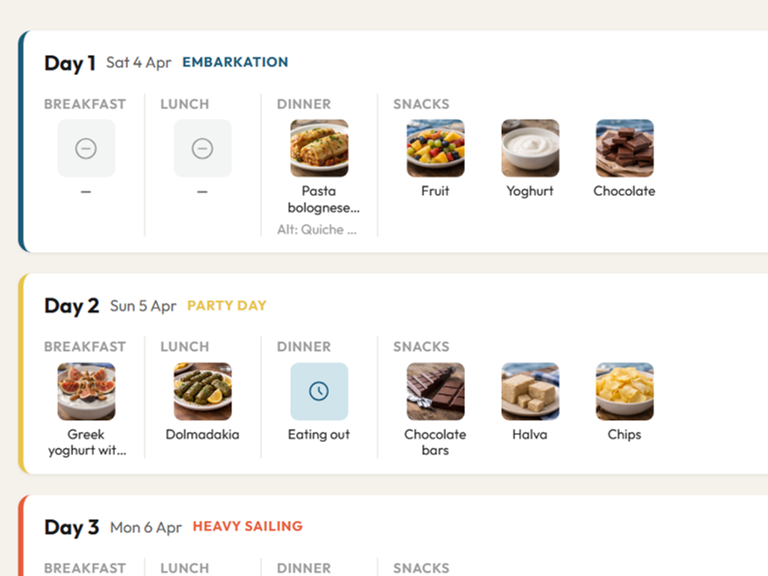
Heavy Sailing day — no-cook meals assigned automatically
Walk into the supermarket and just shop.
No mental math. No forgotten items. No "I think we need..." guessing.
Every ingredient from every meal → one list, grouped by aisle, in real units. Quantities scale for crew size and trip length automatically.
Edit quantities, add your own items, then check them off in-store on your phone. It’s a working document — not a read-only report.
Export as PDF, CSV, or text to share with crew before departure.
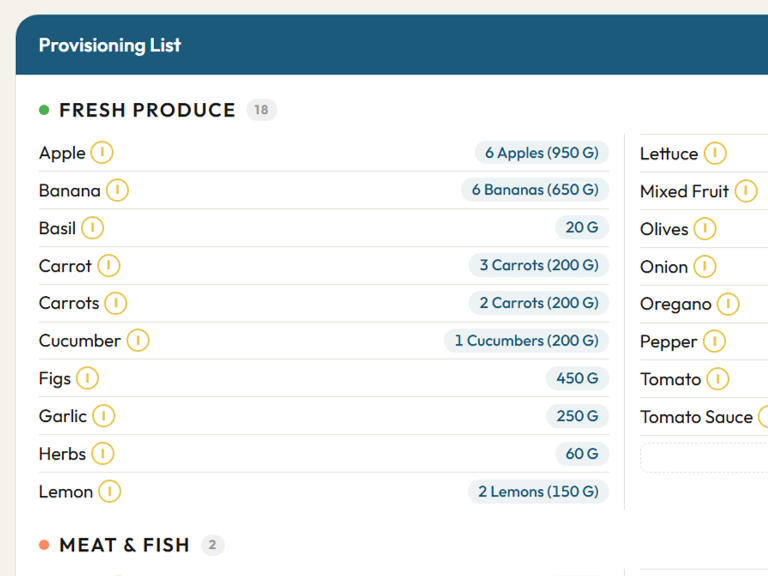
Exact quantities — grouped by supermarket category
Collect everyone’s preferences without chasing messages.
Crew diets are the #1 source of provisioning errors. Victuo handles them before they become problems.
Send a link. Guests fill in diets, allergies, breakfast style, snack preference, and cuisine likes. You review and approve when ready.
Don’t wait for everyone — start planning now, fold in responses later. Each restriction generates an automatic alternative — no separate plan needed.
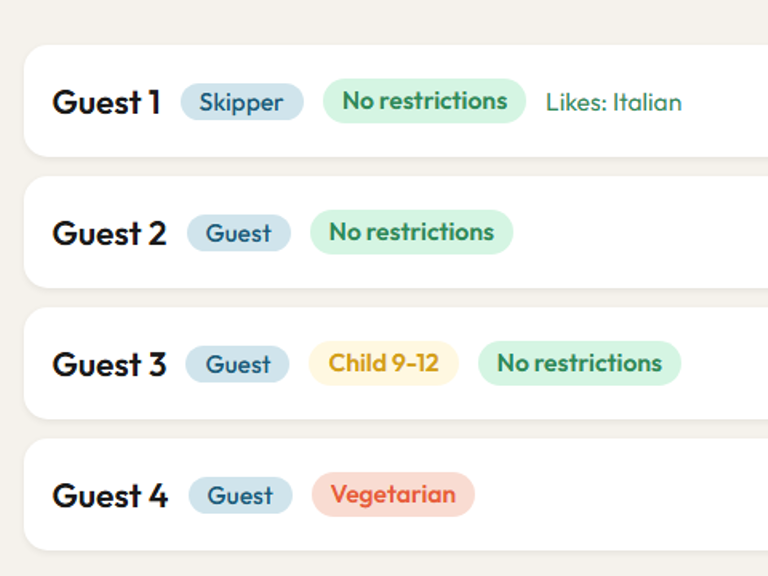
Guests fill in preferences via a shareable link
Know if the plan fits the boat — before you buy.
Yacht storage is limited. Most crews only find out they overbought when they’re at the dock trying to fit everything in.
Fridge, freezer, dry storage — each checked against what the plan requires. Warnings surface before you overbuy.
5 reserve types: shelf-stable backup, emergency calories, hydration buffer, weather delay, quick-serve. Each exists for a reason — not padding.
Fresh food scheduled early. Shelf-stable holds the late days. The balance is automatic — you see the depletion curve across the trip.
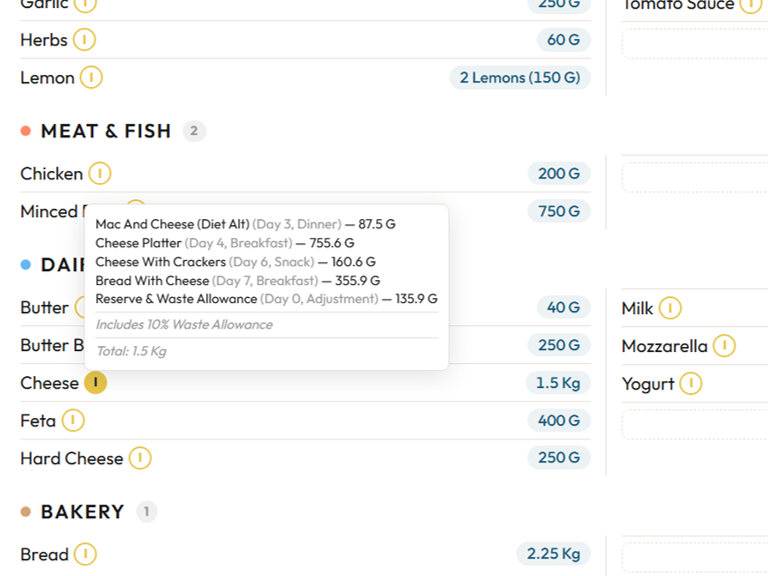
Fridge, freezer, dry — checked against the plan
Water and drinks are 40% of provisioning weight. Most people wing it.
Dehydration is a real risk. Running out of drinks kills morale. And carrying too much wastes precious storage.
Tank vs bottled split. Still vs sparkling. Soft drinks by preference. Beer, wine, spirits — all calculated in one pass alongside food.
Climate adjusts hydration automatically — hotter trip = more water. Reserve buffers handle delays without manual math.

Every drink type calculated alongside food
Know where to restock — before you get there.
Arriving at a marina with no nearby supermarket and a half-empty fridge is avoidable.
51 countries. 1.6M+ locations. Supermarkets, restaurants, chandleries — filtered to coastal areas only. No inland noise.
Each marina gets a restock score: walkable grocery access, store depth, weekend availability. So you can decide what to carry and what to buy later.

Nearby suppliers around your marina stops
Plans change. The system doesn’t break.
Guest cancels. Weather shifts the route. You discover a crew member is pescatarian. None of this should mean starting over.
Swap any meal → quantities recalculate. Lock what you like. Regenerate the rest. Add crew mid-planning — preferences fold in automatically.
Every version is saved. Compare. Roll back. Approve when ready. Planning modes let you shift the whole plan’s bias: balanced, convenience-first, authentic-local, budget, shelf-stable.

Every version saved — swap, lock, regenerate without losing work